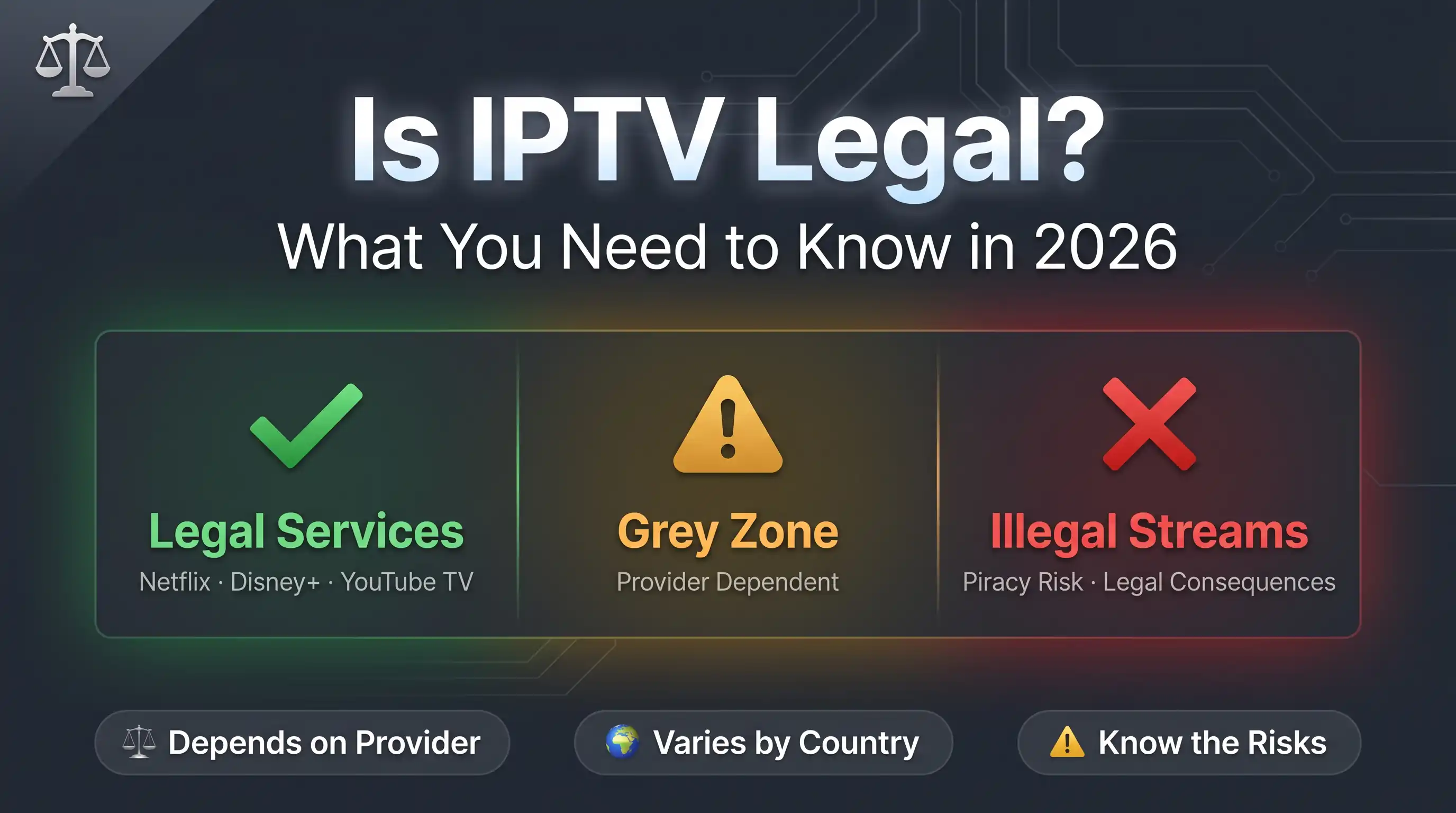
IPTV is legal as a technology. The protocol is identical to what Netflix, YouTube, and BBC iPlayer use to stream video. What determines legality is whether the content provider holds valid broadcasting licences for the channels they deliver. Licensed services are legal. Unlicensed resellers offering thousands of channels at low prices almost certainly are not.
That distinction is what most people miss — and it’s the part that actually matters for your specific situation.
I’m not a lawyer, and nothing here is legal advice. What follows is an accurate summary of how copyright law works in the main countries where IPTV enforcement is active, based on published legislation and reported enforcement actions.
What Makes an IPTV Service Legal or Illegal
One thing: licences.
A broadcaster like Sky, ESPN, or the Premier League spends billions acquiring distribution rights for the content they carry. When you access those channels through an unlicensed service, you’re downstream of a rights violation — not a technicality, an actual infringement under copyright law in most countries.
The US Digital Millennium Copyright Act (DMCA) and equivalent legislation across the EU (Directive 2019/790), UK, Canada, and Australia all reach the same conclusion: streaming unlicensed copyrighted content is infringement. Delivering it over the internet is not a loophole.
Legal IPTV Services
These services are licensed and legal in most countries:
| Service | Type | Notable content |
|---|---|---|
| Netflix | VOD + live | Original series, films |
| Disney+ | VOD | Marvel, Star Wars, Disney |
| Hulu Live | Live TV | US sports, news, local |
| YouTube TV | Live TV | 100+ US channels |
| Sling TV | Live TV | Cable channels, sports |
| DAZN | Live sport | Boxing, football, MMA |
| BBC iPlayer | Free live/catch-up | UK residents only |
| Pluto TV | Free live/VOD | Ad-supported |
What these have in common: named content partners, published licences, and pricing that reflects what those rights actually cost.
What Most “IPTV Subscriptions” Actually Are
The subscriptions sold through Telegram channels, WhatsApp groups, and discount reseller panels almost never hold broadcasting rights for what they deliver.
Common tells:
- 5,000–20,000+ channels for under $15/month
- No company name, address, or registration number
- Crypto or Revolut-only payments
- Channels drop constantly — no service agreement keeps them live
- No branded app; delivered through TiviMate, IPTV Smarters, or other third-party players
Some regional providers hold legitimate local rights at genuinely low prices. But if you can’t find out who runs the service or what they’re licensed for, that’s your answer.
Is IPTV Legal in the US?
Streaming unlicensed content in the US violates the Digital Millennium Copyright Act and the No Electronic Theft Act. Both cover reproduction of copyrighted works, including streaming.
For providers: Running an unlicensed IPTV service is a federal crime. The Department of Justice and Homeland Security Investigations have prosecuted dozens of US-based operations since 2020, with sentences including multi-year prison terms.
For end users: No individual viewer has been criminally prosecuted in the US solely for watching unlicensed streams. Enforcement targets operators. Civil suits from rights holders targeting individual viewers exist but are rare and typically settle for small amounts.
“Low enforcement risk” and “legal” are not the same thing.
Is IPTV Legal in the UK?
The UK has some of the most active IPTV enforcement in the world, and it has been expanding.
The Police Intellectual Property Crime Unit (PIPCU) and the Federation Against Copyright Theft (FACT) both run dedicated IPTV investigation units. Unlike most countries, UK enforcement has started moving beyond sellers toward buyers.
In 2023, a Manchester man received a suspended sentence specifically for selling IPTV subscriptions. Courts have also ruled that using an unauthorised decoder device to watch premium channels — Sky Sports and BT Sport in particular — constitutes infringement under retained EU copyright law, a ruling that survived Brexit.
Unlicensed Premier League football is a specific enforcement priority. If you’re in the UK watching top-flight sport on a £10/month service, you’re in a jurisdiction that treats this as an active investigation matter, not just a civil risk.
Is IPTV Legal in Europe?
The EU Copyright Directive 2019/790 criminalises both distribution and deliberate use of unlicensed streams. How aggressively each country enforces it varies considerably:
| Country | Enforcement level |
|---|---|
| Italy | Very high — ISP blocking + user notices |
| Germany | High — rights holders send cease-and-desist letters to end users |
| France | High — ARCOM blocks thousands of IPTV domains monthly |
| Spain | Moderate — active against large resellers |
| Netherlands | Moderate |
| Eastern Europe | Generally low |
A few countries worth specific attention:
Italy operates the most aggressive enforcement in Europe. Its Piracy Shield platform (launched January 2024) requires ISPs to block flagged IPTV addresses within 30 minutes of a complaint. End users can also receive ISP notices. The system has expanded its scope repeatedly since launch and is actively lobbied for by Serie A and other sports rights holders.
Germany is the most active at targeting individual viewers. Rights holders — often through specialist law firms — send Abmahnungen (cease-and-desist letters) demanding settlement payments from individuals caught accessing unlicensed streams. Settlement demands typically run €500–1,500. German courts have consistently upheld this practice.
France focuses primarily on ISP-level blocking via ARCOM, which blocks thousands of IPTV domains monthly. End users are not typically targeted directly, but ARCOM has been pushing for stronger individual-level tools.
Is IPTV Legal in Canada?
Federal Court injunctions require Canadian ISPs to block unlicensed IPTV sources. Selling unlicensed subscriptions is clearly illegal. Individual viewers face minimal enforcement risk today, though the CRTC has been under sustained pressure from rights holders to introduce stronger consumer-level tools — so the current low-risk environment for viewers is not guaranteed to stay that way.
Is IPTV Legal in Australia?
Courts have ordered ISP-level blocking of piracy sites including IPTV portals. Like Canada, enforcement targets distributors — but Australian courts have expanded these blocking orders further than almost any other common law jurisdiction. Rights holders have also used the Federal Court to compel ISPs to update block lists as services move to new domains, making it harder to work around.
The Actual Risks for End Users
The legal risk of watching unlicensed IPTV as a private individual is low in most countries. That’s not the same as zero, and it’s definitely not the same as legal. It means enforcement is practically focused elsewhere right now.
The risks worth thinking about aren’t only legal:
| Risk | Likelihood (end user) |
|---|---|
| Criminal prosecution | Very low — enforcement targets sellers |
| Civil lawsuit from a broadcaster | Low — rare, usually settled |
| ISP warning letter | Low to moderate in UK, Italy, Germany |
| ISP throttling or disconnection | Possible in some countries |
| Malware from unofficial APKs | High — the real immediate danger |
The malware problem is genuinely underestimated. Many unofficial IPTV APKs distributed through Telegram contain adware, cryptominers, or spyware. An app that delivers 20,000 channels for free has to generate revenue somewhere — sometimes the product is access to your device.
How to Tell if Your IPTV Service Is Legitimate
Four checks before you commit to a subscription:
- Find the company. Search the service name alongside “broadcasting licence” or “company registration.” Legitimate operators have a traceable legal entity. If you find nothing, that tells you something.
- Look at the pricing. Anything under $5/month for 1,000+ channels is not covering content licensing costs. Real licences are expensive. The maths doesn’t work.
- Check for an official app. Apps on the Apple App Store and Google Play must pass review. Unlicensed IPTV services almost never appear there.
- Test your credentials. Before paying anything, run your M3U or Xtream Codes credentials through the IPTV Checker to confirm the streams actually work and your subscription is valid.
Where Things Stand
| Situation | Legal status |
|---|---|
| Netflix, Disney+, Hulu, YouTube TV | Legal |
| Your ISP’s streaming app | Legal |
| Free ad-supported services (Pluto TV, Peacock Free) | Legal |
| Licensed regional IPTV operator | Legal |
| Budget reseller, 10,000+ channels, no company info | Almost certainly illegal |
| Watching unlicensed streams as an end user | Illegal in most countries; enforcement risk is low |
| Selling unlicensed subscriptions | Illegal and actively prosecuted |
The technology is legal. What runs on top of it may not be. If you can’t verify who licences the content your provider is selling you, that’s worth acting on.
Frequently Asked Questions
Practically, individual viewers are rarely prosecuted. Enforcement focuses on distributors and resellers. The most immediate risk is malware from unofficial apps, not legal action.
Using a VPN is legal in most countries. It doesn't make unlicensed content legal — it may reduce your visibility to your ISP but doesn't remove liability.
In the US: YouTube TV, Sling TV, or Hulu Live. In the UK: Sky Stream, BT TV, or Virgin Media. For sports globally: DAZN.
Kodi is open-source software and fully legal. Add-ons that stream unlicensed content are not.
TiviMate is a licensed app available on Google Play. The app is legal. Whether your subscription is legal depends on your provider, not the player you use to watch it.